

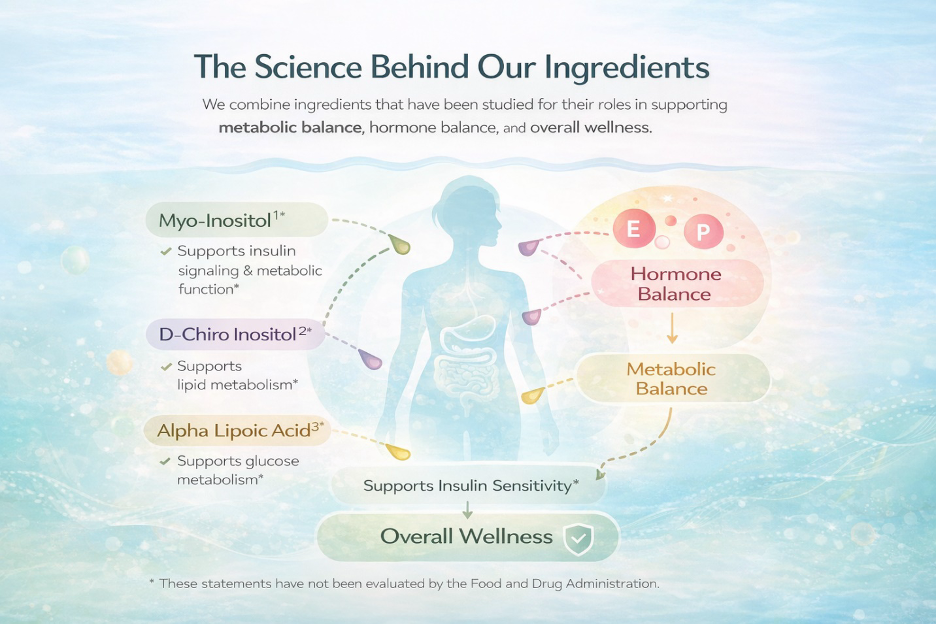
The Science Behind Our Ingredients
At PCOSKEY®, our formulations are built around ingredients that have been studied for their role in supporting metabolic, hormonal, and cellular health.
We reference publicly available research and nutritional science when selecting ingredients to support overall wellness.
Inositol (Myo-Inositol & D-Chiro Inositol)
- Supports insulin signaling and metabolic function*
- Supports hormonal balance and ovarian function*
Myo-inositol has been studied for its role in insulin sensitivity and endocrine function in women with PCOS¹².
L-Carnitine
- Supports cellular energy production*
- Supports lipid metabolism*
L-carnitine supplementation has been studied for its effects on metabolic profiles in women with PCOS³.
Alpha Lipoic Acid (ALA)
- Supports glucose metabolism*
- Provides antioxidant support*
Alpha lipoic acid has been studied for its role in insulin sensitivity and oxidative stress pathways⁴.
Coenzyme Q10 (CoQ10)
- Supports cellular energy production*
- Provides antioxidant support*
CoQ10 has been studied for its role in supporting metabolic markers in women with PCOS⁵.
Magnesium
- Supports glucose metabolism*
- Supports metabolic balance*
Magnesium has been studied for its role in metabolic health and insulin function⁶.
Zinc
- Supports normal hormone metabolism*
- Supports metabolic function*
Zinc supplementation has been studied for its effects on endocrine and metabolic markers⁷.
Vitamin D
- Supports immune and metabolic health*
- Supports hormone-related functions*
Vitamin D has been studied for its association with metabolic and hormonal balance in PCOS⁸.
B Vitamins (Folate & Vitamin B12)
- Support methylation and cellular processes*
- Support energy metabolism*
Folate and B vitamins have been studied for their role in metabolic and inflammatory pathways⁹.
Antioxidants (Astaxanthin, Pine Bark Extract)
- Provide antioxidant support*
- Support cellular health*
Oxidative stress has been studied as a contributing factor in metabolic imbalance, and antioxidants may help support cellular protection¹⁰.
Botanical Ingredients
- Cinnamon extract has been studied for metabolic support*
- Plant-based compounds are commonly used in wellness formulations*
Cinnamon supplementation has been studied for its potential role in glucose metabolism¹¹.
Our Approach
We formulate our products using ingredients that have been studied in nutritional science and clinical research. Our formulations are designed to support overall wellness as part of a balanced lifestyle.
References
The following references correspond to the numbered citations used throughout this page. These studies relate to individual ingredients and are provided for educational purposes only.
¹ Unfer, V., Facchinetti, F., Orrù, B., Giordani, B., & Nestler, J. E. (2012). Myo-inositol effects in women with polycystic ovary syndrome: A meta-analysis of randomized controlled trials. Endocrine Connections, 1(3), 139–146. https://doi.org/10.1530/EC-12-0059
² Bevilacqua, A., & Bizzarri, M. (2018). Physiological role and clinical utility of inositols in polycystic ovary syndrome. Best Practice & Research Clinical Obstetrics & Gynaecology, 53, 61–72. https://doi.org/10.1016/j.bpobgyn.2018.05.001
³ Samimi, M., et al. (2016). Effects of L-carnitine supplementation on metabolic profiles in women with PCOS. Clinical Endocrinology, 84(6), 851–857. https://doi.org/10.1111/cen.12952
⁴ Masharani, U., et al. (2011). Alpha-lipoic acid improves insulin sensitivity. Diabetes Care, 34(3), 675–680. https://doi.org/10.2337/dc10-1557
⁵ Izadi, A., et al. (2019). Coenzyme Q10 supplementation improves metabolic profiles in women with PCOS. Clinical Endocrinology, 91(2), 260–268. https://doi.org/10.1111/cen.13970
⁶ Jamilian, M., et al. (2017). Magnesium supplementation and metabolic outcomes in women with PCOS. Biological Trace Element Research, 181(1), 37–43. https://doi.org/10.1007/s12011-017-1011-3
⁷ Jamilian, M., et al. (2016). Effects of zinc supplementation on endocrine outcomes in women with PCOS. Biological Trace Element Research, 170(2), 271–278. https://doi.org/10.1007/s12011-015-0466-7
⁸ Wehr, E., et al. (2009). Association of vitamin D deficiency with metabolic disturbances in PCOS. European Journal of Endocrinology, 161(4), 575–582. https://doi.org/10.1530/EJE-09-0432
⁹ Kilicdag, E. B., et al. (2005). Homocysteine levels in women with PCOS: Effects of folic acid treatment. Human Reproduction, 20(6), 1521–1526. https://doi.org/10.1093/humrep/deh835
¹⁰ Rizzo, M., et al. (2013). Role of antioxidants in metabolic disorders. Current Pharmaceutical Design, 19(34), 6070–6080. https://doi.org/10.2174/13816128113199990350
¹¹ Hajimonfarednejad, M., et al. (2018). Cinnamon supplementation and insulin resistance: A systematic review. Food Science & Nutrition, 6(2), 276–285. https://doi.org/10.1002/fsn3.561
Disclaimer
These references are provided for informational purposes only. The findings described relate to individual ingredients and do not necessarily reflect the effects of finished products.
* These statements have not been evaluated by the Food and Drug Administration. This product is not intended to diagnose, treat, cure, or prevent any disease.