

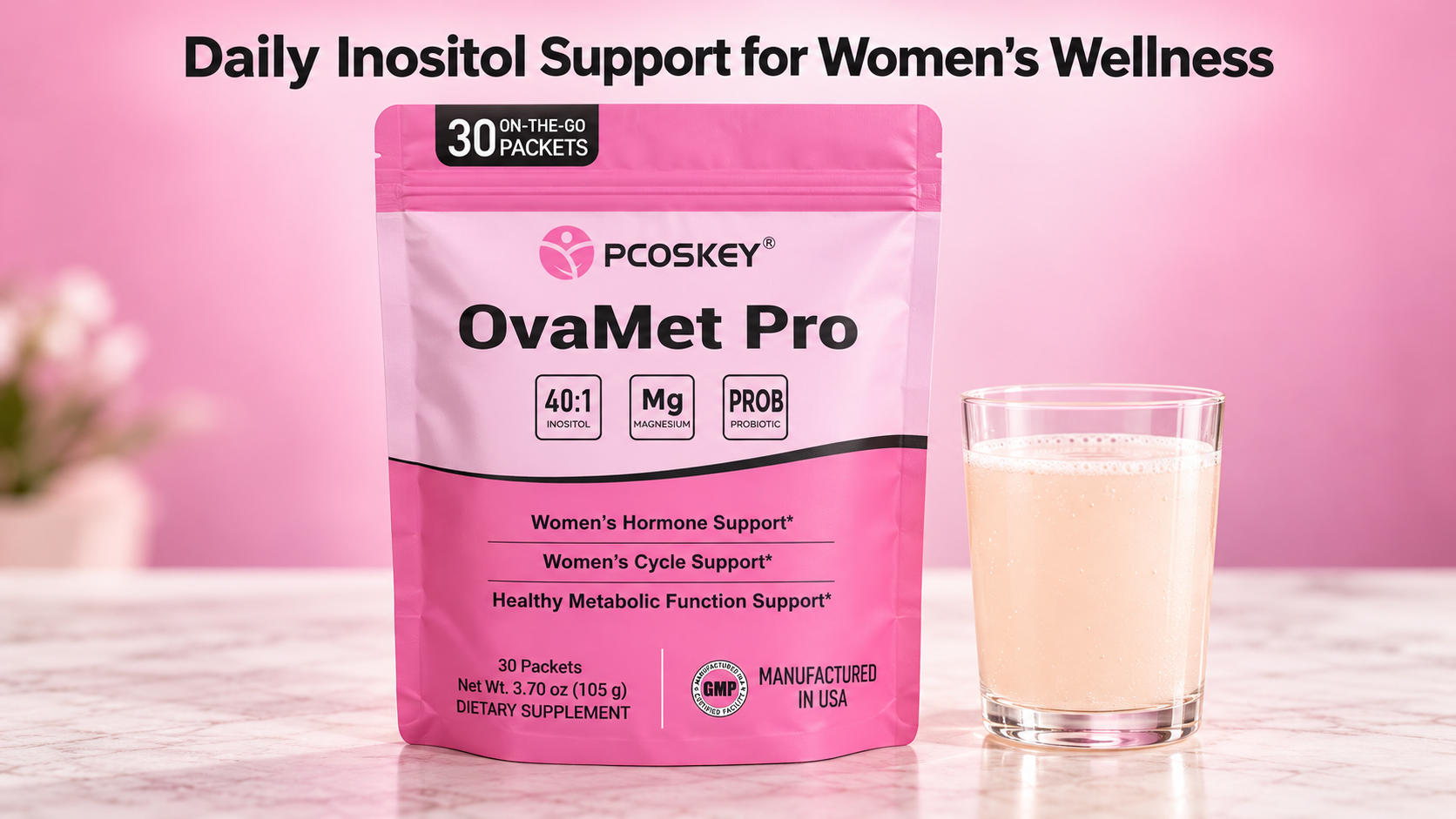

The short answer: Myo-inositol and D-chiro-inositol are two forms of the same nutrient, and the body assigns them different jobs. Healthy tissue keeps far more of the myo form on hand — roughly forty parts myo-inositol for every one part D-chiro-inositol. That is why a well-built inositol supplement copies the 40:1 proportion instead of loading up on either form alone.
Quick facts
- Inositol is a vitamin-like compound your body makes on its own and also absorbs from food.
- Nine forms of inositol occur in nature; myo-inositol and D-chiro-inositol are the two that matter in supplements.
- In blood and in the fluid around the egg, the two forms sit at about 40 parts myo to 1 part D-chiro.
- Myo-inositol handles most of the day-to-day signaling work; D-chiro-inositol is produced from it in small, targeted amounts.
- Studies of myo-inositol most often use 2 to 4 grams per day.
- A trustworthy label lists each form with its own amount, never just a combined blend total.
What inositol is, in plain terms
Inositol is a carbohydrate-like compound that your body can synthesize from glucose. You also eat it regularly: beans, whole grains, citrus fruit, and melon are all decent sources. Inside your cells, inositol becomes part of messenger molecules that pass instructions from the cell surface to the machinery inside. Some of those messengers belong to the insulin pathway — the chain of signals that tells your body how to handle blood sugar after a meal. Because that signaling role touches both metabolism and ovarian function, inositol has become one of the most studied nutrients in women’s hormonal health.
Of the nine natural forms, two dominate the research and the supplement shelf: myo-inositol and D-chiro-inositol. They share the same basic structure and differ only in the orientation of one small chemical group, yet the body treats them as distinct tools.
Why inositol comes up so often with PCOS
Search for PCOS nutrition advice and inositol appears almost immediately — and there is a logical reason for that. Polycystic ovary syndrome is a hormonal and metabolic condition, and a large share of women who have it also have some degree of reduced insulin sensitivity, including women at a healthy weight. A nutrient that participates directly in insulin signaling naturally attracts research attention in that context.
Researchers have also looked at how the balance between the two forms may behave in PCOS. The enzyme that converts myo-inositol into D-chiro-inositol is insulin-dependent, so when insulin signaling is off, the conversion pattern — and the local ratio in tissues such as the ovary — may shift as well. That is one reason the conversation around inositol for PCOS focuses on proportions, not just total grams.
A clear boundary is worth stating: inositol is a nutrient, not a medication. Women generally add it to a broader routine — food, movement, sleep, and clinician-guided care — to support healthy insulin function, hormone balance, and regular cycles. It does not treat PCOS, and no supplement can stand in for medical care.
Myo-inositol: the form doing the heavy lifting
Myo-inositol is the most plentiful form in the body and in the diet. It is concentrated in follicular fluid, the environment that nourishes a developing egg, and it takes part in the early steps of insulin signaling as well as in signaling connected with ovarian function. The large majority of published inositol studies use this form, usually in gram-level amounts, which is why powders and drink mixes are such a common format: delivering several grams through capsules alone would mean a handful of pills a day.
For general metabolic and hormonal support, myo-inositol is the foundation ingredient. If a label features only one form of inositol, it is almost always this one.
D-chiro-inositol: the specialist, dosed small on purpose
D-chiro-inositol is not eaten in meaningful amounts and is not meant to be. Your tissues manufacture it from myo-inositol through an enzyme step, producing it locally, in the places and moments it is required. Its responsibilities sit further along the insulin pathway, particularly in signals related to storing energy as glycogen.
Because the body makes it sparingly, supplemental amounts are small — a standalone D-chiro product commonly provides 600 mg — and small is correct here. D-chiro-inositol is potent in its lane, but its lane is narrow. A focused DCI routine can make sense when it is chosen deliberately, ideally with a clinician who knows your labs; it is not simply a stronger version of a blend.
Why the 40:1 ratio matters more than the total milligrams
The 40:1 figure is not a marketing slogan. It is the proportion researchers actually measure in healthy blood and follicular fluid, and it is the ratio used in many of the clinical studies women read about. Different tissues keep different proportions, but for the blood and ovarian environment the 40-to-1 split is the reference point.
The ratio also protects against a real mistake. Since the ovary depends heavily on myo-inositol, flooding the body with large amounts of D-chiro-inositol by itself can tilt the local balance the wrong way; researchers have linked high-dose, DCI-only intake with less favorable egg-quality markers, a tension sometimes called the D-chiro paradox. A 40:1 blend sidesteps that problem by design: abundant myo-inositol for the everyday work, plus a measured amount of the specialist form — the same arrangement your body maintains on its own.
How to choose an inositol supplement
A few minutes of label reading will tell you more than any advertisement:
- Both forms, both amounts. Look for myo-inositol and D-chiro-inositol named separately, each with its own milligram figure. Skip products that hide the split inside a proprietary blend with only a combined weight.
- Do the division. Take the myo amount and divide by the D-chiro amount. A result near 40 means the formula respects the body’s ratio. As a reference, 2,000 mg of myo-inositol pairs with about 50 mg of D-chiro-inositol.
- Pick the format you will keep using. A 40:1 drink mix such as OvaMet Pro suits women who prefer a once-a-day powder routine; capsules suit women who want grab-and-go simplicity. Consistency over months beats format every time.
- Know when DCI alone fits. Single-ingredient D-chiro products — our DCI 600 mg provides D-chiro-inositol 600 mg with vitamin D3 — are for targeted routines, not as an everyday default for everyone.
- Check the honest basics. Serving size, servings per container, and cost per month should all be easy to work out from the label.
- Budget real time. Most studies run eight to twelve weeks or longer. Judge any inositol routine on that horizon, not on a fortnight.
Five common inositol mistakes
- Assuming D-chiro is the “strong” form. More DCI is not better; beyond small amounts it can work against the balance you want.
- Buying a blend that never discloses its ratio. If the two amounts are not printed, the ratio cannot be verified — and probably was not designed.
- Expecting medication-style results on a medication-style timeline. Inositol supports normal physiology gradually, as part of a routine.
- Treating inositol as a weight-loss shortcut. It is metabolic support, not a diet product; no honest label will promise pounds lost.
- Stacking several inositol products without adding up the totals. A blend plus a standalone DCI can quietly push D-chiro intake higher than intended.
Frequently asked questions
Can I take inositol every day?
Inositol has a long record of daily use and is generally well tolerated at typical amounts; mild digestive discomfort is the complaint heard most often. If you are pregnant, nursing, taking medication, or managing a diagnosed condition, review it with your clinician first.
How long should I give an inositol routine before judging it?
Plan on at least eight to twelve weeks, which matches the length of most published studies. Inositol is nutritional support, not a quick fix, and cycles themselves need time to respond to any routine.
Should I choose a 40:1 blend or D-chiro-inositol on its own?
For broad metabolic and hormonal support, the 40:1 blend is the usual starting point because it mirrors the body’s own proportions. A DCI-only product fits narrower, deliberate situations — ideally chosen with professional guidance.
Can inositol be combined with other supplements?
It is frequently used alongside folate, vitamin D, and magnesium. The main caution is arithmetic: check how much of each nutrient you are getting across everything you take.
Does inositol treat PCOS?
No. Inositol is a dietary supplement that supports healthy insulin function and hormone balance; it is not intended to diagnose, treat, cure, or prevent PCOS or any other disease. Women with PCOS should keep their clinician in the loop about any supplement routine.
These statements have not been evaluated by the Food and Drug Administration. This product is not intended to diagnose, treat, cure, or prevent any disease. This article is educational information only and is not medical advice.