


Short answer first: When a couple has trouble conceiving, the male partner is part of the picture in roughly half of cases — about 20–30% as the sole factor, and another 20–30% alongside a female factor. Yet preconception advice is still aimed almost entirely at women. Making a sperm cell takes about 90 days, so a man’s habits and medical checks today show up in his sperm roughly three months from now. Preconception is a shared 90-day project — and the first step, a semen analysis, is the simplest test in fertility care.
Quick Facts
- About 1 in 6 people of reproductive age experience infertility at some point (WHO).
- Male factors are involved in roughly 40–50% of couples’ fertility difficulties (AUA/ASRM).
- Sperm take about 64 days to form, plus 10–14 days to mature — clinicians round this to 90 days.
- A semen analysis is inexpensive, non-invasive, and should be one of the first tests, not the last.
- Large trials have not shown that antioxidant or zinc supplements improve pregnancy or live-birth rates in men. They support nutritional status; they are not a proven fertility treatment.
Half the equation, by the numbers
Fertility is usually talked about as a woman’s story. The numbers tell a different story. Infertility — not conceiving after 12 months of regular, unprotected intercourse — affects roughly 8–17% of couples. Within that group, the American Urological Association and the American Society for Reproductive Medicine put a purely male factor at about 20% of cases, with male factors contributing alongside female factors in another 30–40% — male involvement in approximately 40–50% of infertile couples overall.
There is a second reason men’s health belongs here: men evaluated for infertility have higher rates of other medical conditions, and 1–6% are found to have a previously undiagnosed condition.
None of this is about blame. It is about leverage: when half the picture sits with one partner, a plan that ignores him works at half strength.
The 90-day clock
The most useful fact in male preconception is a timeline: spermatogenesis takes roughly 64 days, and new sperm need another 10–14 days maturing in the epididymis — about 90 days in total.
That timeline cuts both ways. A rough month — a high fever, heavy drinking, a medication that affects sperm — can show up in a semen analysis weeks later, and a good three months of steady habits shows up too. Judging a new routine after two weeks tells you nothing: the sperm tested today began developing before the routine started.
For couples, that means a shared calendar: the female partner’s window is the same three months an egg needs to mature. Starting together is the simplest way to run the project.
The first test: a semen analysis
If there is one step couples should take early, it is this one: a semen analysis, a simple, painless laboratory test of a sample produced at the clinic or at home. It is far less involved than almost any test the female partner will face — which is why it should come first, not last. Too often it comes after months of female-side investigation, when it could have answered basic questions on day one.
The test measures volume, sperm count and concentration, motility, and shape. WHO’s 2021 reference values: total count of 39 million or more per ejaculate, concentration of 16 million or more per milliliter, at least 30% progressively motile, and at least 4% normally shaped.
Two cautions. First, these values are not a pass/fail line — the WHO says so itself — and a single low result should be repeated about three months later, because sperm numbers vary. Second, a normal result does not test everything; it says little about sperm DNA integrity. If results are abnormal, the next step is a urologist, who may check hormones, look for a varicocele (the most common correctable cause of male infertility), and review medications.
What actually moves the needle
Supplements get most of the attention here, but the strongest evidence belongs to ordinary habits. A 2026 randomized trial found diet-induced weight loss in men with obesity significantly increased sperm concentration and count, with improvements still present a year later. Excess body fat shifts hormone balance and raises scrotal temperature.
Smoking damages sperm DNA and is linked to lower counts and motility; quitting is the highest-impact change for a smoker. Alcohol: heavy drinking lowers testosterone and sperm production — cutting back sharply, or stopping while trying, is the cautious choice. Heat: sperm production needs a temperature about 2°C below core body temperature, so frequent hot tubs, laptops on the lap, and tight clothing all work against it; the effect is reversible once the heat source is removed. Sleep and stress shift hormone signaling when short or chronic. Medications and steroids: anabolic steroids and testosterone therapy suppress the body’s own sperm production, sometimes severely, as do some drugs for blood pressure, hair loss, and mood. Review every prescription and supplement with a clinician before trying.
None of these is a guarantee, and none of this is about fault. They are levers.
Nutrients, honestly: what the evidence actually shows
This is where honesty matters most: the supplement aisle tells a simpler story than the research does. Several nutrients are genuinely involved in sperm biology: zinc supports normal testosterone levels and sperm formation; selenium supports normal spermatogenesis; folate supports DNA synthesis; CoQ10 and L-carnitine are involved in the cellular energy that powers sperm movement; and antioxidants such as vitamin E, lycopene, and astaxanthin help defend cells against oxidative stress. Correcting a deficiency is straightforward good nutrition.
But the step from ‘involved in the biology’ to ‘taking more improves pregnancy chances’ is where the evidence thins. A 2022 Cochrane review of 90 trials with over 10,000 subfertile men found antioxidants may improve some semen measures, but the effect on live birth remained uncertain. A large 2020 trial of folic acid plus zinc found no improvement in live-birth rates. The UK’s NICE 2026 guideline therefore makes no recommendation to offer vitamins or antioxidants to men to improve fertility. In plain terms: a supplement can support nutritional status; it cannot honestly be sold as something that makes conception happen.
That changes how to shop: a formula worth taking covers the basics at sensible amounts and names every ingredient with its own dose, making no promises. One to skip hides behind proprietary blends, stacks megadoses, or claims to treat infertility.
How to read a men’s preconception label
The same checks from our earlier articles apply: every nutrient named with its own amount; folate spelled out as 5-MTHF rather than only folic acid; zinc and selenium in a sensible range (roughly 15–30 mg of zinc and 100–200 mcg of selenium a day); a serving size you will actually take every day for three months; and no disease language.
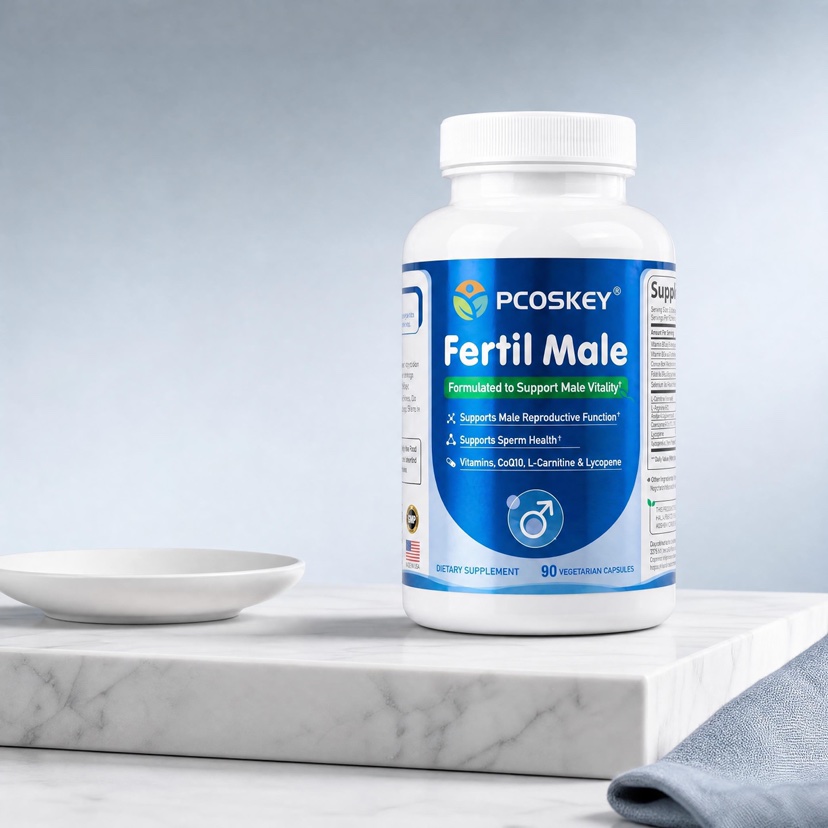
Our Fertil Male was built on that checklist: three capsules a day providing zinc bisglycinate 25 mg, selenium 110 mcg, folate as 5-MTHF 680 mcg DFE, vitamin D3 50 mcg (2,000 IU), vitamin E 150 mg, L-carnitine fumarate 700 mg, acetyl-L-carnitine 300 mg, L-arginine 350 mg, CoQ10 100 mg, lycopene 25 mg, and astaxanthin 4 mg — each named, each dosed, nothing hidden in a blend.* It supports sperm health and male reproductive function as part of a preconception routine — not as a replacement for testing or medical care. Because preconception is a two-person project, it pairs with the female partner’s side of the same window — see our earlier article on egg quality basics.
A shared 90-day plan
Three months before you start trying, begin together: book a preconception check each, with a semen analysis early rather than late; review every medication with a clinician; stop smoking and cut alcohol. He keeps laptops off his lap, skips the hot tub, moves daily, and takes his preconception formula every day. She covers folate, cycle tracking, and the same sleep, movement, and alcohol steps. Pick a start date, mark the 90 days, and agree when to seek help — after 12 months of trying (6 months if the female partner is over 35), or sooner with irregular cycles, a known condition, or an abnormal semen analysis.
Trying for a baby is one of the few health projects that is genuinely shared: same timeline, same window, same goal. It does not guarantee an outcome — nothing can — but neither partner carries the whole weight alone, and neither half of the equation goes unchecked.
Frequently asked questions
How long before trying should a man start a preconception routine?
At least three months — that is how long sperm take to develop and mature.
Do male fertility supplements improve pregnancy chances?
Large trials have not shown improved pregnancy or live-birth rates from antioxidant or zinc supplements in men. They support nutritional status; they do not treat infertility or replace testing or medical care.
When should we see a specialist?
After 12 months of trying (6 months if the female partner is over 35), or sooner with irregular cycles, a known condition, or an abnormal semen analysis — and the male partner should be evaluated at the same time, not months later.
These statements have not been evaluated by the Food and Drug Administration. This product is not intended to diagnose, treat, cure, or prevent any disease. This article is educational information, not medical advice. Always talk to your clinician before starting a new supplement, especially if you take medication or have a medical condition.