


Short answer first: When researchers talk about egg quality, they mean three things at once: an egg’s energy supply, the protection of its DNA, and whether it can mature and divide cleanly. That is why the same short list keeps showing up in studies — CoQ10 for cellular energy, active folate (5-MTHF) for DNA building and cell division, and antioxidants such as NAC, alpha-lipoic acid, and resveratrol for defense against oxidative stress. None is a guarantee, and none replaces medical care, but knowing what each one is supposed to do makes a supplement label much easier to judge.
Quick Facts
- An egg takes roughly three months to develop from a resting follicle to an ovulation-ready egg, so routines are judged over months, not days.
- Eggs carry far more mitochondria — the cell’s energy-making structures — than almost any other cell, which is why energy nutrients get so much attention.
- Folate builds DNA and supports cell division; the active form, 5-MTHF, is the form the body can use directly.
- Oxidative stress is an imbalance between reactive oxygen species and antioxidant defenses; it can damage membranes, DNA, and mitochondria.
- Most human studies here are small, and many were done in IVF clinics rather than in women trying naturally.
What “egg quality” actually means
There is no single lab test that scores egg quality the way a blood test scores cholesterol. Clinicians infer it from observations: how many eggs mature, how cleanly they divide, how well they fertilize, and how embryos develop afterward. Age matters in a way no supplement can undo, because egg numbers decline and chromosome errors become more common. A nutrient routine can only work with the eggs a woman already has; it cannot create new ones or repair chromosome errors. The nutrients below support normal cellular function during a long, energy-hungry maturation process — not a way to turn back the clock.
CoQ10: the energy nutrient
Coenzyme Q10 (CoQ10) is a fat-soluble compound the body makes on its own. Inside mitochondria, it helps carry electrons along the chain that produces ATP, the energy currency every cell runs on, and it also acts as an antioxidant. Eggs are unusually demanding for both jobs: maturation, division, and the first divisions after fertilization all require large amounts of energy, and eggs contain an exceptionally high number of mitochondria to supply it.
The research story is promising but unfinished. In aging mice, CoQ10 restored aspects of egg and mitochondrial function that had declined with age. Human evidence comes mostly from small trials in women with diminished ovarian reserve undergoing IVF. A 2024 meta-analysis of six randomized trials (about 1,500 women) reported more eggs retrieved and higher clinical pregnancy rates with CoQ10 pretreatment, and a 2020 meta-analysis reported a similar pattern. But the trials were small and uneven, no large trial has shown a live-birth improvement from CoQ10 alone, and European guidance on fertility add-ons (ESHRE, 2023) does not recommend routine antioxidant therapy in assisted reproduction.
Doses in trials reporting positive results generally fell between 200 and 600 mg per day, often for two to three months before a treatment cycle, matching the roughly 90-day maturation timeline.
Folate and 5-MTHF: the DNA-building nutrient
Folate, vitamin B9, is essential for making DNA and RNA and therefore for every round of cell division — including the rapid divisions of a maturing egg and a developing embryo. Food folate and the active supplement form, 5-methyltetrahydrofolate (5-MTHF, also called L-methylfolate), are already in the form the body uses. Folic acid, the synthetic form in most standard supplements and fortified foods, is not: it must pass through several conversion steps, including one driven by the MTHFR enzyme, before it becomes 5-MTHF.
That conversion step is where individual differences come in. Some people carry MTHFR gene variants that make conversion less efficient, so the same folic acid dose raises active folate levels less. A 2020 review concluded the active form may offer advantages there, and a 2025 systematic review found active folate associated with higher blood folate levels in women of childbearing age. None of this makes folic acid “bad” — it has decades of public-health evidence behind it, and authorities generally recommend 400–800 mcg of folate daily preconception. The practical point: checking whether a formula lists folate as 5-MTHF (or L-methylfolate) rather than only as folic acid tells you whether it skips the conversion step.
Folate supports normal cell division; it does not by itself improve egg quality, and high doses are not better by default. Add up total intake across all products first.
The antioxidant team: NAC, alpha-lipoic acid, resveratrol, and L-carnitine
If CoQ10 is about energy and folate is about building material, antioxidants are about defense. Oxidative stress arises when reactive oxygen species — normal metabolic byproducts, increased by smoking, excess alcohol, poor sleep, and environmental exposures — outrun the body’s defenses. In the ovary, that imbalance is linked to poorer follicle development and oocyte quality, and the same mechanism affects sperm.
Each antioxidant in the usual lineup defends differently:
- N-acetylcysteine (NAC) is a building block for glutathione, one of the body’s own master antioxidants. Small trials in women with PCOS have reported improved ovulation markers with NAC, though results vary and doses differ across studies.
- Alpha-lipoic acid (ALA) works in both watery and fatty parts of the cell, protecting membranes as well as cell fluid, and helps recycle other antioxidants such as vitamins C and E.
- Resveratrol, the polyphenol in grape skins, is studied for antioxidant and cell-signaling effects; human fertility evidence is still early.
- L-carnitine shuttles fatty acids into mitochondria for energy, sitting at the overlap of the energy and defense stories, and is also studied for sperm motility and quality.
Reviews of antioxidant therapy for couples (a 2024 comprehensive review and the 2020 Cochrane review) reach the same conclusion: the biology is plausible and some trials report better intermediate outcomes, but optimal doses, combinations, treatment length, and who benefits most remain unsettled. More is not automatically better — the body needs some reactive oxygen species for normal signaling, including ovulation — so megadose stacking is a poor strategy.
How to read an egg-quality label without being misled
A trustworthy label makes five things easy to check:
- Each nutrient named with its own amount. “Antioxidant blend 870 mg” tells you far less than a label that breaks the blend down. Hidden amounts make comparison and total-intake math impossible.
- The folate form spelled out. Look for “folate (as 5-MTHF)” or “L-methylfolate,” not just “folic acid,” if active folate is what you want.
- A CoQ10 amount in the studied range. Trials generally used 200–600 mg per day; a token sprinkle at the bottom of a long blend is a different product from a formula built around it.
- A realistic serving size. A “30-day supply” requiring six capsules a day only works if you will actually take six capsules a day. Consistency beats ambition.
- No disease language. A legitimate supplement supports normal function — “supports egg quality” or “supports healthy ovarian function.” Any label promising to treat infertility, reverse aging, or guarantee pregnancy is over the line, whatever its ingredients.
The rest of the routine still matters more than any capsule
Sleep, smoking, alcohol, weight extremes, and chronic stress all shift oxidative balance and hormone signaling over the same three-month window as any supplement. A routine that adds a formula while ignoring those levers works against itself. A varied diet — leafy greens, legumes, citrus, nuts, oily fish, whole grains — may already cover several of these nutrients; a supplement then fills gaps rather than replacing meals.
Where PCOSKEY fits, honestly
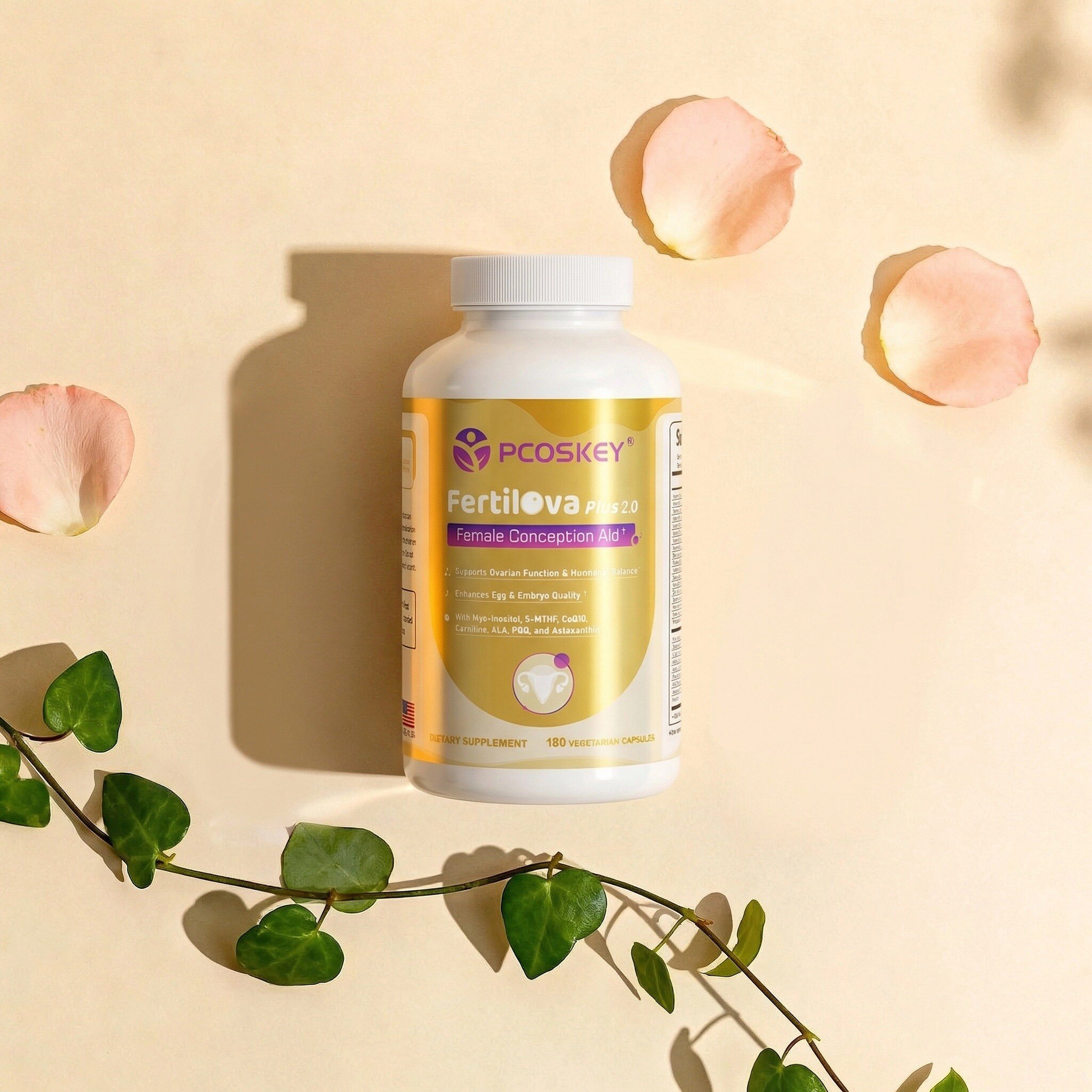
Two of our formulas were built around the nutrients above. Fertilova Plus pairs 2,000 mg of myo-inositol with 400 mg of CoQ10 per daily serving (six capsules) — inside the range used in the trials above — and supports egg quality, hormone balance, and cycle regularity.* Our PCOSOVA includes active folate as 5-MTHF alongside vitamin B6 as P-5-P, and supports menstrual cycle health, healthy insulin function, and healthy androgen balance.* For inositol in full, see our earlier article on myo-inositol vs. D-chiro-inositol and the 40:1 ratio. If your clinician has recommended a different dose or folate form, their advice outranks this article.
Frequently asked questions
How long should I take a preconception nutrient routine before expecting anything?
Think in three-month blocks. An egg’s maturation takes roughly 90 days, and most studies run at least eight to twelve weeks. Judging a routine after two weeks tells you nothing.
Is 5-MTHF better than folic acid for everyone?
Not necessarily. Folic acid has the longest public-health track record, and many women convert it well. Active folate’s advantage is clearest where conversion is less efficient. Total daily folate from all sources matters most.
Can I take several antioxidant products at once?
Do not stack blindly. Add up overlapping ingredients — especially CoQ10, NAC, and folate — across every product you take, and check with a clinician if totals climb well above typical supplemental ranges.
Do these nutrients treat infertility or PCOS?
No. Supplements support normal nutrition and cellular function; they do not diagnose, treat, cure, or prevent any disease, including infertility or PCOS. If conception has not happened after twelve months of trying (six months if you are over 35), or sooner with irregular cycles or a known condition, talk to a clinician rather than adding another product.
These statements have not been evaluated by the Food and Drug Administration. This product is not intended to diagnose, treat, cure, or prevent any disease. This article is educational information, not medical advice.